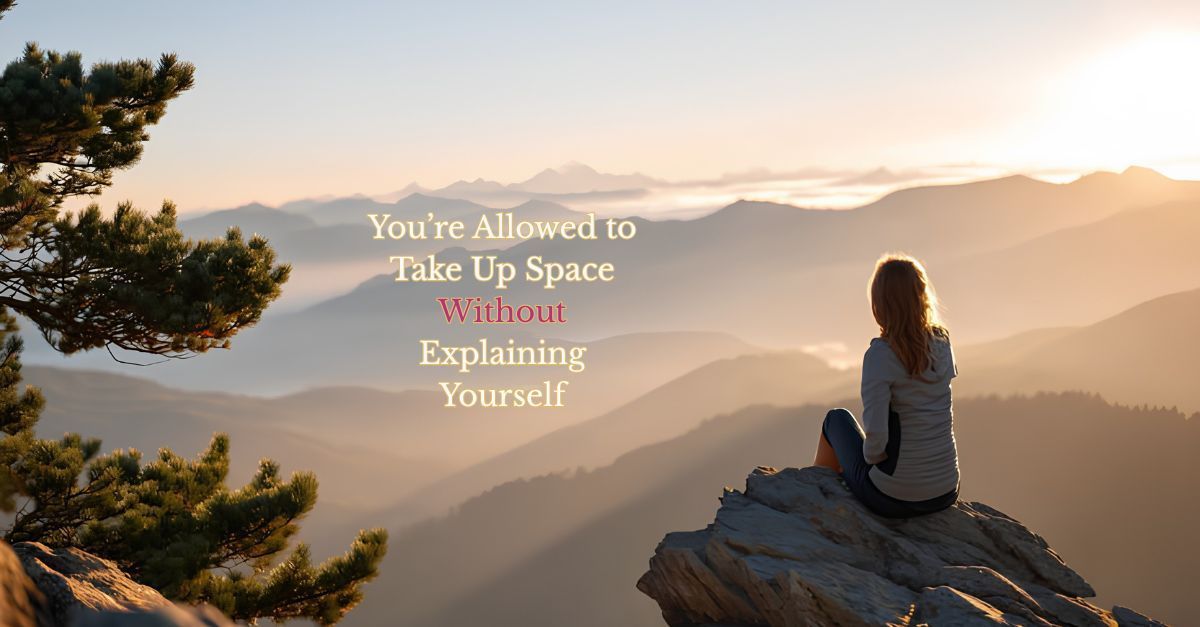
You’re Allowed to Take Up Space Without Explaining Yourself
For a long time, I thought needing to explain myself was just part of being considerate. Explaining why I was tired, why I needed time, why something felt hard when it didn’t seem hard for others. It looked like maturity, emotional intelligence, awareness.
But underneath it, there was something else entirely. Fear. Fear that my needs wouldn’t be believed unless they were justified. Fear that if I didn’t explain myself well enough, I’d be seen as difficult, dramatic, or “too much.” Fear that taking up space without permission would cost me safety. So I learned to pre-emptively soften everything. I’d over-explain my emotions, minimise my needs while describing them, apologise before anyone had even responded. And for a long time, I didn’t realise this wasn’t politeness, it was a nervous system response.
When you grow up or live in environments where your emotions are misunderstood, dismissed, or overwhelming to others, your system adapts. It learns that needs are only safe if they’re reasonable. That rest is only allowed if it’s earned. That taking up space requires proof.
Constant explaining is often a sign that safety has been missing. When a nervous system doesn’t trust it will be met with understanding, it goes into management mode. It edits. It monitors. It anticipates rejection before it happens. Over time, this teaches you to outsource your self-trust. You start checking whether your needs are valid through other people’s reactions. You wait for permission before resting. You negotiate with yourself about whether something “counts” as hard enough.
That’s not because you’re insecure. It’s because your system learned that being fully expressed wasn’t safe.
One of the biggest shifts in my own healing didn’t come from learning to communicate better. It came from learning to stop justifying my existence. To say, “I need rest,” and let that be enough. To feel something deeply without immediately translating it into something more palatable. To notice the urge to explain and gently question where it came from.
Here’s what I now understand on a nervous system level: in safe relationships and environments, explaining becomes optional. When safety is present, the body relaxes. When the body relaxes, the need to over-justify disappears. When the system trusts it won’t be punished for having needs, it stops bracing.
This is why healing isn’t just about confidence or boundaries. It’s about felt safety. You can know, intellectually, that you’re allowed to take up space, and still feel a physical urge to shrink. You can believe in your worth, and still feel anxious when you assert it. That doesn’t mean you’re doing healing “wrong.” It means your nervous system is still catching up to the truth.
Inside the work I do, and especially inside The Empress Collective, we don’t force people to take up space before they’re ready. We don’t push confidence. We don’t override the body’s signals. We create safety first. Because when safety is consistent, something really important happens: people stop explaining. They stop apologising for existing. They stop rehearsing their needs in their heads before voicing them. Not because they’ve become harder or louder, but because they’ve become more secure.
Taking up space doesn’t mean dominating a room or demanding attention. Sometimes it looks like:
- Saying no without a paragraph of context
- Resting without guilt
- Feeling deeply without self-censoring
- Allowing your experience to exist as it is
You don’t owe the world a justification for your humanity. If you notice yourself constantly explaining, try not to shame that part of you. It learned that strategy for a reason. Instead, ask gently: where did I learn that my needs required permission? Healing isn’t about ripping that strategy away. It’s about slowly teaching your system that you’re safe now.
When safety becomes familiar, taking up space stops feeling like a risk and starts feeling like home. If you’re craving a space where you don’t have to perform, explain, or shrink to belong, this is exactly the kind of work we hold inside The Empress Collective. You’re allowed to arrive as you are, no justification required.